
Planning a move and trying to pin down the cost of movers in Maine? It’s the first question almost everyone asks before they book — and the honest answer is that it depends. Not in a vague, dodge-the-question way, but because a move has real moving parts, and each one nudges the price. The good news is that once you know what those parts are, the number a mover gives you will actually make sense. Here’s how Maine moving costs break down in 2026, and how to get a quote you can plan around.
How much do movers cost in Maine?
The cost of movers in Maine depends on three things above all: how far you’re going, how much you’re moving, and when you move. A local move within Maine costs far less than a long-distance one, and summer always runs higher than winter. For your real number, you’ll need an estimate built around your home.
Those three levers — distance, volume, and timing — set the baseline for nearly every move. A studio apartment moving across Portland is a few hours of work for a small crew. A four-bedroom house heading from Bangor to North Carolina is a different job entirely, priced on weight and miles instead of the clock. Most moves land somewhere in between, and the rest of this guide walks through exactly what pushes a quote up or down.
Here’s why we won’t slap a single dollar figure on the page: a “Maine moving cost” pulled from an online calculator is a guess. It doesn’t know about the piano in your living room, the third-floor walk-up with no elevator, or the dirt driveway a truck can’t climb in April. It can’t see that your closing date slipped and now you need a week of storage. Real pricing also shifts with fuel, demand, and the season, so any number we posted today could be wrong by next month.
A proper estimate accounts for all of it — the size of your home, what’s actually in it, where you’re going, how easy the place is to get in and out of, and any specialty items or packing you need. That’s why the most useful thing we can do here is show you what really drives the price, then give you a real quote for your move.
How much do local movers cost in Maine?
Local movers in Maine — meaning a move within the state that’s usually done in a single day — are priced by the hour. The bill covers your crew, the truck, and travel time, with a minimum number of hours. The smaller and more organized your home, the faster it loads, and the less you pay.
Home size is the biggest lever here. A one-bedroom apartment in Portland might take a two-person crew a few hours, start to finish. A four-bedroom house in Bangor or Brunswick can fill most of the day and call for a third or fourth mover. More movers means a higher hourly rate, but the job also finishes sooner — so a bigger crew on a big house often lands in the same place in the end, with less standing around.
A few things change how long the clock runs:
- Stairs and walk-ups. A third-floor apartment with no elevator takes longer than a one-level ranch.
- The carry. If we can’t park at the door — common on the tight streets of Portland’s Old Port — the crew walks every item farther, and that adds time.
- How packed you are. Boxes sealed, labeled, and stacked by the door let the crew load fast. A half-packed kitchen on move morning slows the whole day down.
- Packing materials. Boxes, tape, and wrap show up on the bill if you need them from us.
Because all of that is specific to your home, the only way to know your local rate is to ask — and rates do change, so we’d rather quote you straight than post a number that’s stale by the time you read it. You can see everything our local crews handle on our local moving page, or call (207) 890-7475 for today’s pricing.
How are movers priced by the hour in Maine?
Local Maine movers are priced by the hour, but the exact structure varies — some charge a flat hourly rate for the whole crew and truck, others charge per mover per hour. Either way, the clock usually starts with travel time, and most companies set a minimum number of hours you’ll be billed for.
The part that trips people up isn’t the rate itself — it’s what’s actually on the clock. For most local moves, billable time includes a lot more than loading and unloading:
- Travel time. Many movers charge for the drive to your home and back to home base, or build in a flat travel fee. The farther you are from where the crew starts the day, the more this matters — a job in Portland is closer to most of our trucks than one out in Belfast or Augusta.
- Drive time between stops. Moving across town or to the next county? The time on the road between your old place and the new one is usually on the clock too.
- The minimum. Nearly every company sets a minimum number of hours, so even a one-room move has a floor. Worth knowing if you’ve only got a few things to shift.
Once you’re past the minimum, time is typically billed in set increments — often quarter-hour blocks — so a job that runs a little long doesn’t jump a whole hour.
Here’s the thing about comparing hourly quotes: the rate alone won’t tell you the total. A low hourly number paired with a long minimum, a separate travel fee, and marked-up materials can run higher than a slightly bigger rate with everything rolled in. So when you call around, ask the same three things every time — what the rate covers, how travel time is charged, and whether materials are extra. We’ll spell all of it out before you book, so the figure you hear is the figure you pay. For your current hourly rate, call (207) 890-7475 or request a free estimate.
How much does a long-distance move from Maine cost?
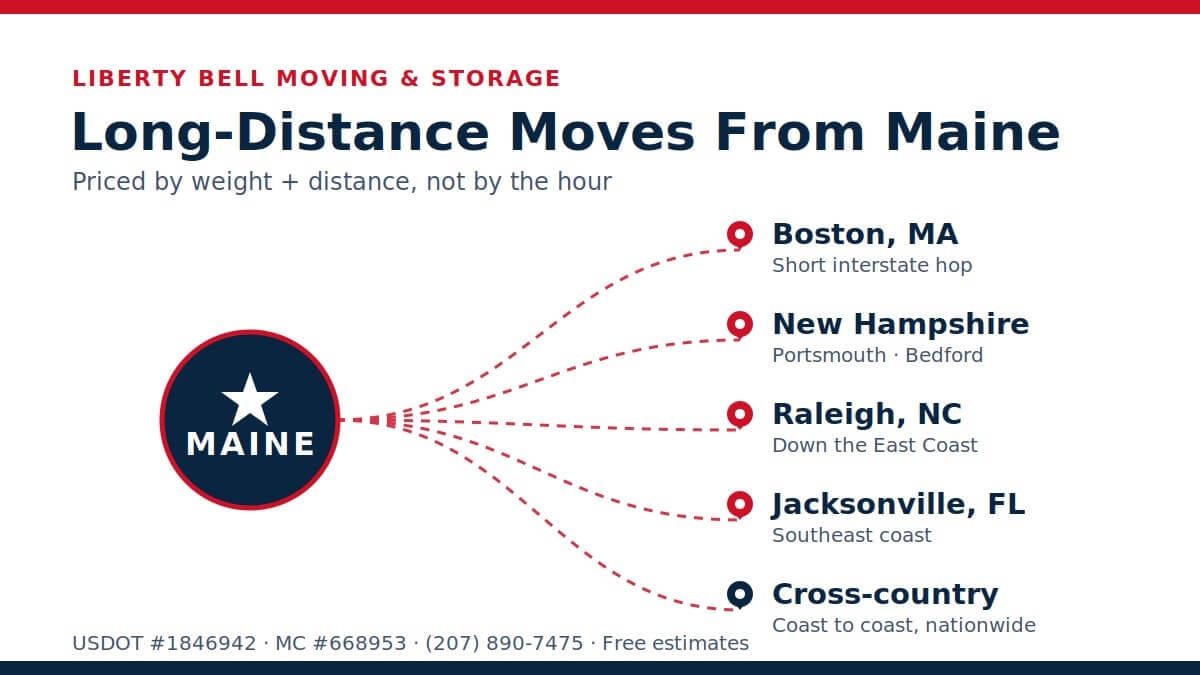
A long-distance move from Maine — any move that crosses state lines — is priced on the weight of your shipment and the miles to your destination, not by the hour. The farther you’re going and the more you’re moving, the higher the cost. Weight and distance are the two big drivers.
Instead of an hourly clock, interstate movers estimate your shipment weight from a home inventory — sometimes confirmed with a certified scale ticket — then price the miles to your door on the other end. Because Maine sits up in the corner of the country, “long distance” from here covers a wide spread:
- New England and the Northeast. Short interstate hops like Portland to Boston, or a move into New Hampshire. Closer destination, lower mileage, lower cost.
- Down the East Coast. Maine to North Carolina (Raleigh, Kinston) or Florida (Jacksonville) is a serious haul — well over a thousand miles — and the price reflects it.
- Cross-country. The full run out to the Mountain states or the West Coast.
A few things beyond weight and distance still move the number:
- Access at both ends. A third-floor walk-up or a no-parking street in your new city adds labor, same as it would here in Maine.
- Packing. Long hauls take a beating on rough highway, so full packing and padding matter more, not less.
- Specialty items. Pianos, safes, and antiques need the same careful handling on a 1,200-mile move as a cross-town one.
- Storage in transit. If your closing dates don’t line up — common on a cross-country move — your things may sit in storage for a stretch, which adds cost.
Two pieces of advice for any long-distance move out of Maine. First, ask for a binding or guaranteed estimate so your price is locked before the truck pulls out — you don’t want a surprise when your belongings are already on the road. Second, only hire a licensed interstate mover. We carry USDOT #1846942 and MC #668953, we’re bonded and insured, and we hold an A+ rating from the Maine Better Business Bureau. That licensing isn’t red tape — it’s your protection if something goes wrong a thousand miles from home.
You can see how we handle moves out of state on our long-distance moving page. For a current quote on your specific route, call (207) 890-7475 or request a free estimate.
What affects the cost of your move in Maine?
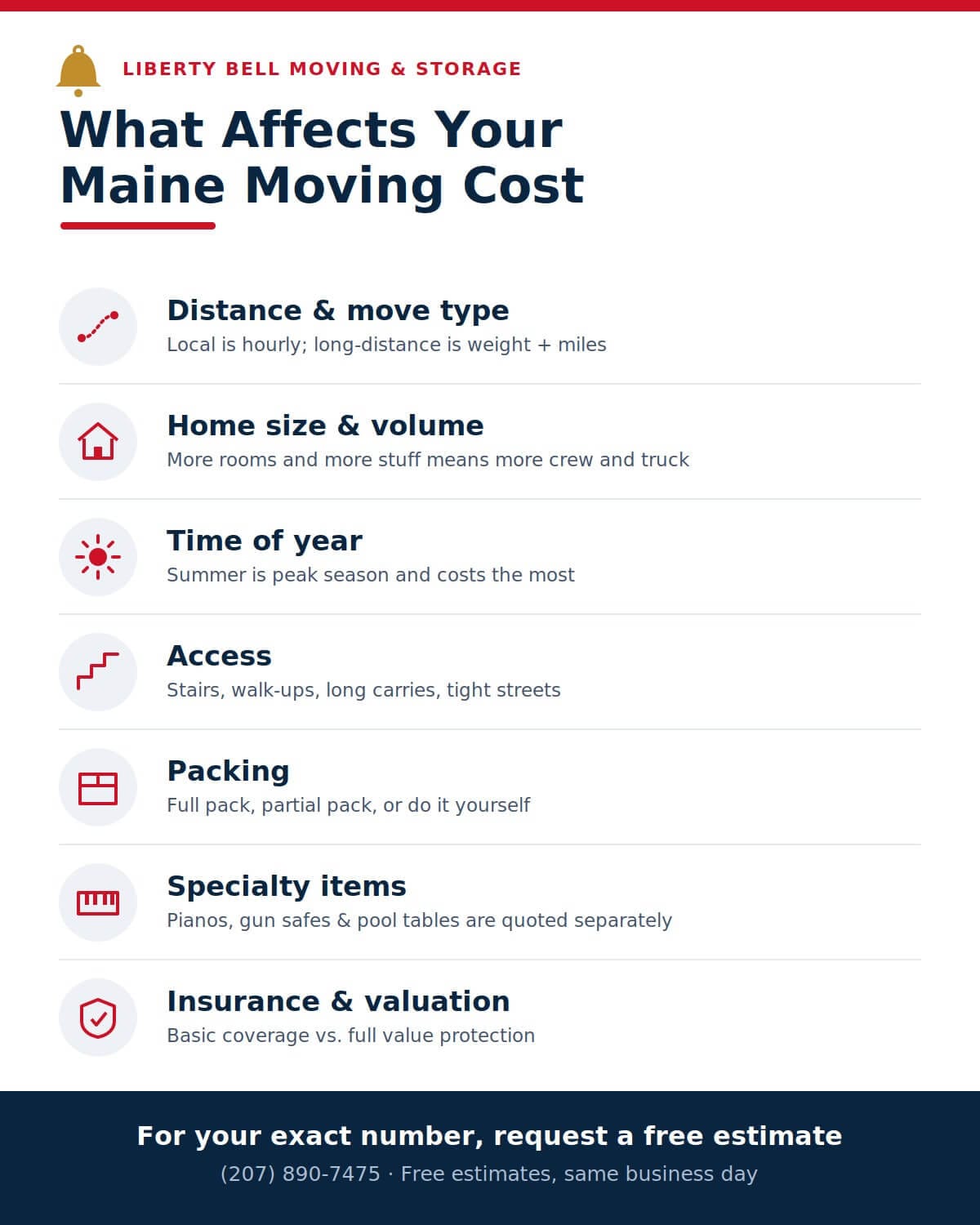
Beyond distance and home size, your moving cost in Maine moves with a handful of factors: how easy your home is to get in and out of, the time of year, any specialty items, whether you add packing, and the level of insurance coverage you choose. Two homes with the same amount of stuff can cost very differently.
Think of your quote as the sum of a few levers. Some you can’t change — where you’re going, how much you own. Others you can. Here’s the full set, so nothing on your estimate catches you off guard:
- Distance. Local moves run on the hourly clock; long-distance moves run on weight and miles.
- Home size and volume. More rooms and more stuff means more crew, more truck space, and more time.
- Access. Stairs, walk-ups, long carries, and tight streets like Portland’s Old Port all add labor at one end or both.
- Time of year. Summer is peak and costs more — more on that in the next section.
- Packing. Pack it yourself to save, or have us do it to save the work.
- Specialty items. Pianos, gun safes, pool tables, and home gyms are quoted separately.
- Insurance and valuation. This one trips people up, so it’s worth a closer look.
Let’s take that last one. Every mover includes a basic level of coverage, often called released value protection. It’s typically included at no extra charge — but it pays out by weight rather than what an item is actually worth, so if a heavy dresser gets damaged, basic coverage might only cover a fraction of replacing it. For more peace of mind, you can buy full value protection, where the mover repairs, replaces, or reimburses an item at its real value. It costs more, but on a long-distance haul with anything fragile or valuable, plenty of Maine families decide it’s worth it. Ask what’s included and what upgrading runs when you get your estimate.
The takeaway: most of these levers are yours to pull. Move off-peak, declutter before the crew arrives, pack the easy boxes yourself, and settle your coverage up front — and you’ve shaped the price before we ever load the truck.
Does the time of year change moving costs in Maine?
Yes — and in Maine the swing is bigger than most people expect. Summer is the busiest and priciest time to move, roughly May through August, when leases turn over and college towns empty out. Fall and winter are quieter, with more open dates and often better rates.
Summer runs the show. From May through August, apartment leases roll over, families try to move before the school year starts, and Maine’s college towns — Orono, Brunswick, Lewiston — clear out and fill back up within weeks. Add in everyone who waited for warm weather, and the calendar gets crowded fast. Saturdays in June and July are the first dates to go. If summer’s your window, book several weeks ahead or you may not get the day you want.
Fall is the quiet secret. September through November still gives you decent weather, but the rush is over, so you’ll usually find more open dates and more room to work with. For a lot of Maine movers, it’s the sweet spot — comfortable temperatures, a shorter wait, often a better rate.
Winter is the cheapest stretch, and the trade-offs are manageable. Demand drops, so dates open up. The catch is the weather: ice on the ramp, walkways that need salting, a truck engine kept running between loads so it starts in the cold, and short daylight that means an early start. Our crews do winter moves all the time — we plan the route around the forecast and keep the path clear. A January move just takes a little more prep, and your wallet may thank you for it.
Then there’s mud season. Late March into April, the frost comes out of the ground and dirt driveways turn soft. A loaded truck can sink or chew up the drive, so we sometimes park at the road and shuttle your things in with a smaller vehicle, which adds a bit of time. Worth a heads-up if you’re out in a rural spot.
The bottom line on timing: your date is one of the few cost levers fully in your control. A midweek, mid-month move in October will almost always beat a Saturday in July. If your schedule has any give, use it — and tell us your flexible dates when you call so we can steer you toward the cheaper ones. Call (207) 890-7475 or request a free estimate to check availability for your window.
How much does packing cost with a Maine moving company?
Packing is usually a separate add-on, priced by how much you want packed and the materials it takes. You can have the crew pack the whole house, just the kitchen and breakables, or nothing at all and box it yourself. The more we pack, the more time and supplies the job takes.
Packing comes in three levels, and which one you choose is the biggest factor in the cost:
- Full pack. We box up the entire house — kitchen, closets, the works — and bring all the materials. It’s the most you’ll pay for packing, and the most time and worry it takes off your plate.
- Partial pack. We handle the tricky stuff — the kitchen, glassware, mirrors, electronics, artwork — and you take the easy boxes. A popular middle ground.
- Self-pack. You box everything yourself and we just load and move it. Cheapest on packing, but it’s on you to do it right.
Two things drive the price either way: labor and materials. Boxes, tape, packing paper, bubble wrap, dish-pack boxes, and wardrobe boxes all add up, and the more fragile or oddly shaped your belongings, the more of them you go through.
Here’s how our crews actually pack, because the how is where breakage gets prevented. Dishes go into dish-pack boxes with cardboard dividers, each piece wrapped on its own. Mirrors, glass tabletops, and framed art go in mirror cartons. We pad-wrap dressers with the drawers still in, then shrink-wrap them so nothing shifts on the road. And every box gets labeled by the room it belongs in, so unloading on the other end is fast — you’re not hunting for the coffee mugs at midnight.
Now the honest trade-off. Packing yourself is the easiest way to trim the bill, and for sturdy, everyday things like books, linens, and clothes, it makes good sense. But there’s a catch: if a box you packed yourself turns up broken, it usually isn’t covered the way professionally packed items are. So the smart move for a lot of Maine families is a partial pack — you handle the linen closet and the bookshelves, we handle the china, the TV, and Grandma’s mirror.
Want to know what packing would run for your home? It comes down to how much you want us to handle, so the figure comes from your estimate. See what’s included on our packing services page, or call (207) 890-7475 and we’ll walk through your options.
What about pianos, gun safes, and other specialty items?
Specialty items cost extra because they need special equipment, more movers, and extra care, so they’re usually quoted on top of the rest of your move. Pianos, gun safes, pool tables, and loaded home gyms aren’t a “grab one end” job — each one changes the crew size and the gear we bring.
Here’s what’s actually involved with the ones we move most:
Pianos. A piano is heavy in all the wrong places, and the weight shifts the second you tip it — which is exactly why we never let a customer grab one end. Our crew uses a piano board and straps, pads the legs and lid, and never runs the job with fewer than three movers. An upright is one challenge; a grand is another, since the legs and pedals usually come off before it’s wrapped and boarded.
Gun safes. A safe can run anywhere from several hundred pounds to well over a thousand, all balanced on a narrow base — and that makes stairs the real danger. We use a heavy-duty dolly, map the path before we lift, and bring enough hands to keep it controlled the whole way. This isn’t a job to improvise.
Pool tables. A pool table almost never moves in one piece. The slate comes apart in sections, the felt and rails come off, and the whole thing has to be reassembled and re-leveled at the new place so it actually plays right. That’s a move and a setup, not just a lift.
Home gym and fitness equipment. Treadmills, cable machines, and weight racks are heavy, awkward, and often need partial disassembly just to clear a doorway. We break down what has to come apart and put it back together on the other end.
We also handle white-glove delivery and custom crating for antiques and fine art through Maine Crating, when something’s valuable or fragile enough to need a box built around it.
The single thing that helps your quote most: tell us about these items up front. When we know there’s a grand piano on the second floor or a 900-pound safe in the basement, we send the right crew with the right equipment and the price is accurate from the start — no scrambling on move day. See how we handle the heavy stuff on our piano moving page, or call (207) 890-7475 to talk through your specialty items.
What hidden or extra costs should you watch for?
The costs people forget are tied to access and add-ons: a long carry from the truck to the door, extra flights of stairs, packing materials, short-term storage between homes, and tipping. None of them are truly hidden — a real estimate spells them out. They only surprise you if you start from a calculator’s guess.
Here’s what most people get wrong about a moving quote: they treat the first number they see as the final one, then feel blindsided when the bill comes in higher. The fix is simple — ask about the items below before you book. None of these are tricks. They’re just the parts of a move that are easy to overlook.
- Long carries. If the truck can’t park near your door — a walk-up complex, a gated lot, a narrow street in the Old Port — the crew carries every item farther, and that time is real. Ask whether your address has a long-carry charge.
- Extra stairs. A flight or two is normal. Beyond that, or a building with no elevator, some movers add for the extra hauling. Mention how many flights when you get your quote.
- Packing materials. Even if you pack yourself, the boxes, tape, and wrap you buy from the mover land on the bill. Round up your own boxes ahead of time to save.
- Appliance and furniture handoffs. Disconnecting a washer, breaking down a bed frame, reassembling it at the new place — these can be part of the job or an add-on. Worth confirming which.
- Short-term storage. This is the big one people miss. When your closing dates don’t line up — you’re out of the old place before the new one’s ready — your things need somewhere to sit. A few days or a few weeks of storage is an extra cost, and on a long-distance move it shows up as storage in transit.
- Tipping. Not a fee, but plan for it. Tipping is customary and never required; most folks base it on the size of the move and how careful the crew was. If they hustled and nothing got scratched, it’s a nice way to say thanks.
The theme across all of these: a good mover tells you about them up front. When you call for an estimate, run through your specifics — the stairs, the parking, the storage gap, the washer that needs disconnecting — and the number you get will be the number you pay. Call (207) 890-7475 or request a free estimate and we’ll account for all of it.
How do you get an accurate moving quote in Maine?
The only way to get an accurate moving quote in Maine is a real estimate — in-home or virtual — where someone actually sees what you’re moving. A calculator guesses; an estimator counts. Then ask for a binding or not-to-exceed price so the number can’t climb after you’ve committed.
Start with the type of estimate. There are really three, and only two of them give you a number worth planning around:
- In-home walkthrough. An estimator comes to your house, opens the closets, checks the basement, and counts what’s actually moving. It’s the most accurate, and it’s the gold standard for a bigger or long-distance move.
- Virtual survey. You walk an estimator through your home over video on your phone. Nearly as accurate as in person and a lot easier to schedule — handy if your days are tight.
- Phone or online ballpark. Fine for a rough sense of scale, but it’s a guess, not a quote. Don’t book a move on it.
Next, know what kind of price you’re actually being handed, because “estimate” can mean three different things:
- Non-binding estimate. A best guess at the cost. Your final bill is based on the actual hours or weight, so it can land higher or lower than quoted.
- Binding estimate. A fixed price for the job as described. As long as your inventory doesn’t change, that’s what you pay.
- Binding not-to-exceed. The one to ask for when you can. You won’t pay more than the quote, but if your shipment weighs less than expected, you pay less. It protects you both ways.
One more thing separates a real quote from a risky one: licensing. We’re bonded and insured, we carry USDOT #1846942 and MC #668953, and we hold an A+ rating from the Maine Better Business Bureau. A suspiciously low number from an outfit with none of that can cost you far more if your belongings get damaged or held up — it happens. Credentials are your proof the quote stands behind something.
To get the tightest number the first time, have a few things ready when you call: a rough room-by-room list of what’s moving, any specialty items like a piano or safe, the stairs and parking at both addresses, whether you want packing, your dates and any flexibility, and whether you’ll need storage between homes. Hand us that, and your quote will be solid. Request a free estimate or call (207) 890-7475, and a Branch Manager will walk you through it.
How can you save money on your Maine move?
The biggest savings on a Maine move come from timing and prep, not from chasing the cheapest crew. Move off-peak — fall, winter, midweek, mid-month — declutter before move day so you’re not paying to haul things you don’t want, and pack the easy boxes yourself.
You can’t change the distance or the price of fuel, but you can shape most of the rest. Here are the levers that actually move your bill, roughly in order of impact:
- Move off-peak. A midweek, mid-month move in the fall or winter beats a summer Saturday almost every time — more open dates, better rates. If your schedule has any give, this is the single biggest win.
- Declutter before move day. You pay to move whatever’s in the house, including the stuff you’ll never unpack. Sell it, toss it, or donate it first. We can even help with furniture donations to Goodwill on your way out, so good pieces find a home instead of a dumpster.
- Pack the easy things yourself. Books, linens, clothes, anything sturdy — box those and leave the kitchen and breakables to us. A partial pack trims labor and materials without risking your china.
- Round up your own boxes. Buy or borrow them ahead of time instead of adding them to the bill on move day. Just keep them sturdy — a box that collapses helps no one.
- Be organized and ready. Boxes sealed, labeled, and stacked by the door. Furniture cleared of clutter. A crew that isn’t waiting on you spends less time on the clock — and on an hourly move, time is money.
- Book early. Last-minute moves cost you options and can land you on premium dates. The more notice you give, the more you can plan around the cheaper days.
A quick word on the all-DIY route, since people always ask. Renting a truck and doing it yourself can look cheaper on paper. But once you add the dolly and pads, the gas, the day or two off work, and the risk of a wrenched back or a dropped dresser, the math gets closer than you’d think — especially for a long move or a house full of heavy furniture. For a small, simple local move it can pencil out. For most others, a crew that does this every day usually earns its keep.
Our moving checklist lays out what to tackle each week so the savings add up instead of piling into a last-minute scramble. When you’re ready for a number, call (207) 890-7475 or request a free estimate.
How Liberty Bell Can Help
Knowing what drives the price is half the battle. The other half is hiring a crew that quotes you straight and treats your home like its own. That’s the part we’ve built our name on across Maine — most of our work comes from repeat customers and referrals, and that only happens if you show up on time and don’t break things.
Whatever your move looks like, we’ve got it covered:
- Local moves within Maine — apartments, houses, and offices, priced by the hour. See local moving.
- Long-distance and interstate moves out of Maine to New England, the Carolinas, Florida, and beyond, with a binding price you can plan around. See long-distance moving.
- Specialty handling for pianos, gun safes, pool tables, and fragile antiques, with the right gear and the right crew every time.
- Packing and storage, as much or as little as you need — from a partial kitchen pack to the whole house.
Behind all of it: a lead foreman on every job, fully bonded and insured service, USDOT #1846942 and MC #668953, and an A+ rating from the Maine Better Business Bureau. Those aren’t bragging rights — they’re your assurance that the people in your driveway know what they’re doing and stand behind the work.
The quote is free and there’s no pressure. Tell us about your move and we’ll give you an honest number for your home, your route, and your timeline.
Frequently Asked Questions
How far in advance should I book movers in Maine?
For a summer move, book several weeks out — peak dates, especially Saturdays from June through August, fill fast. For fall or winter, a week or two is often enough, though more notice always means more dates to choose from.
Are moving costs negotiable?
There’s usually room to shape your total by adjusting what’s included — your move date, packing versus self-packing, or the add-on services you choose. The hourly rate itself is what it is, but the size of the job is largely in your hands.
Do you tip movers, and how much?
Tipping is customary but never required. Most customers base it on the size of the move and how careful the crew was — there’s no set rule. If your movers worked hard and nothing got scratched, a tip is a welcome way to say thanks.
Is it cheaper to move yourself or hire professional movers?
For a small, simple local move, a DIY truck rental can come out cheaper. For anything bigger — heavy furniture, stairs, a long haul — once you factor in the truck, gas, equipment, a day off work, and the risk of damage, professional movers often cost about the same or less in the end.
Do movers charge extra for stairs?
A flight or two is usually built into a normal move. Beyond that, or a walk-up with no elevator, some movers add for the extra hauling. Mention how many flights you’ve got when you get your quote so the number comes back accurate.
Ready to move? Call (207) 890-7475 or request a free estimate — a Branch Manager will get back to you the same business day.